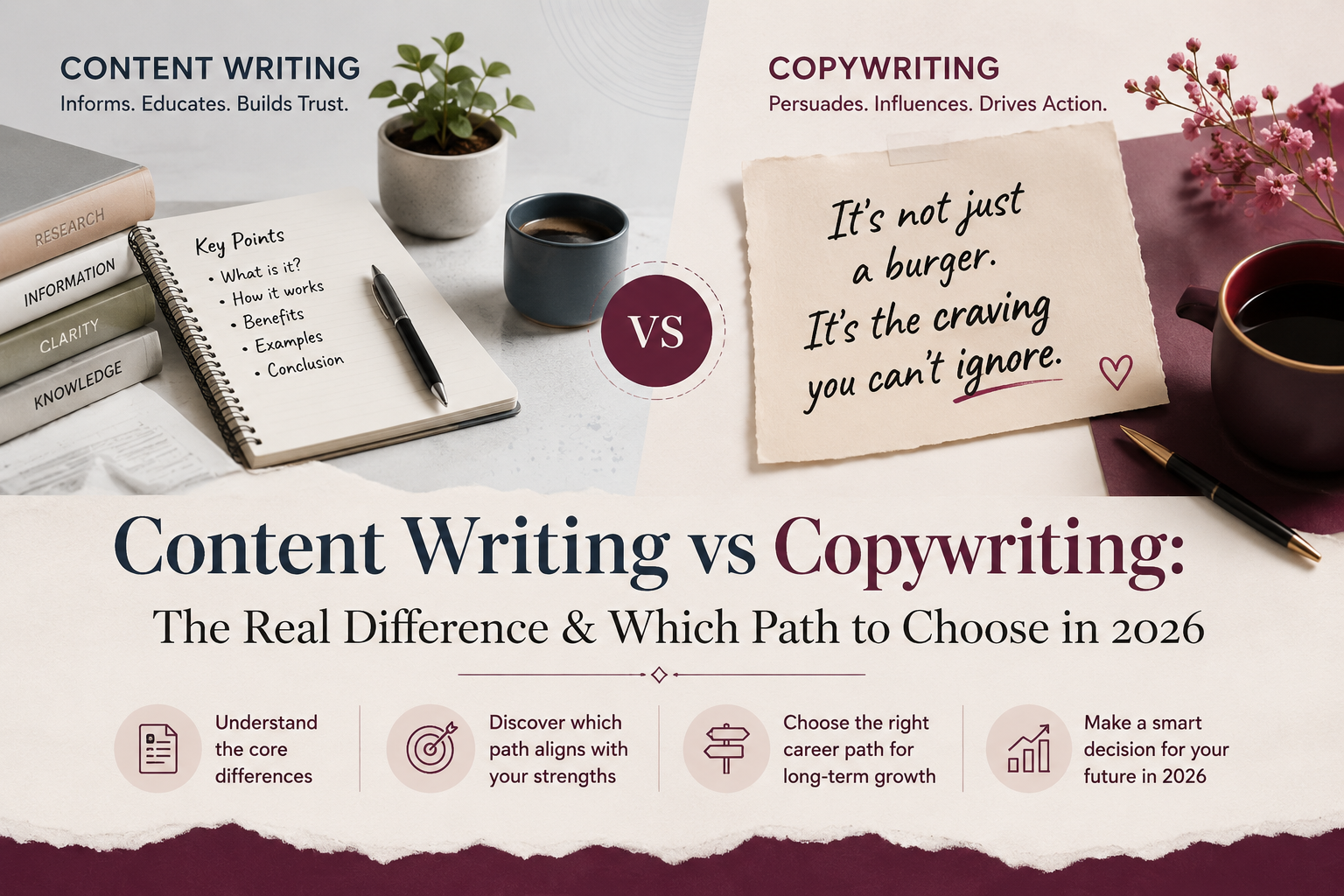
Content Writing vs Copywriting: The Real Difference & Which Path to Choose in 2026
Most people think content writing and copywriting are the same thing.
Even I thought so in my early days, just because both had the word “writing” in them. It felt like we were using two different names for the same thing.
But soon I realised, they are completely different and serve entirely different purposes.
In simple words, content writing focuses on long-form informational writing that helps build long-term value, while copywriting deals with short, crisp content designed to grab instant attention.
So, one builds trust over time, and the other drives immediate actions.
The purpose of this blog is to clear this common confusion around content writing vs copywriting once and for all.
We will explore what content writing and copywriting really mean, how they differ, and how they work together. You will also get clarity on what path to choose or what’s a better fit for you, along with some practical tips and insights to grow as an emerging writer.
Who is this blog for?
If you often get confused between content writing and copywriting and use them interchangeably, this guide is for you. If you are a beginner or planning to grow your writing career, it will help you understand the difference between content writing and copywriting and where to start.
It will also give you clarity and direction to figure out what suits your interests and strengths better, so you know where your true talent lies and choose the right path confidently.
What is Content Writing & Copywriting?
Content Writing
Content writing is a form of writing that focuses on long-form content.
The main purpose of content writers is to deliver educational or informational content. It significantly helps establish authority by building value in the long run.
Examples of content writing include articles, ebooks, and blog posts like the one you are reading right now. This type of long-form content helps readers understand the topic in depth and remains relevant for a long time over the years with timely updates.
Copywriting
Copywriting focuses on writing short and catchy pieces of content.
It is done to instantly grab the audience’s attention and influence them to take action.
The words used to frame the message are kept short and crisp so that the audience remembers it, and a strong impression is created.
Examples of copywriting include ad creatives, email campaigns, social media captions, banners, and hoardings, which are written with just a few powerful words.
Key Differences Between Content Writing & Copywriting
I once saw a simple example that made the difference between content writing and copywriting very clear.
One side described the burger – its ingredients, taste, and price. The other side described the experience of eating it in a way that instantly created a craving.
That’s when I realised the core difference – one informs, and the other persuades.
Here’s a simple visual to illustrate the idea:

Informational burger
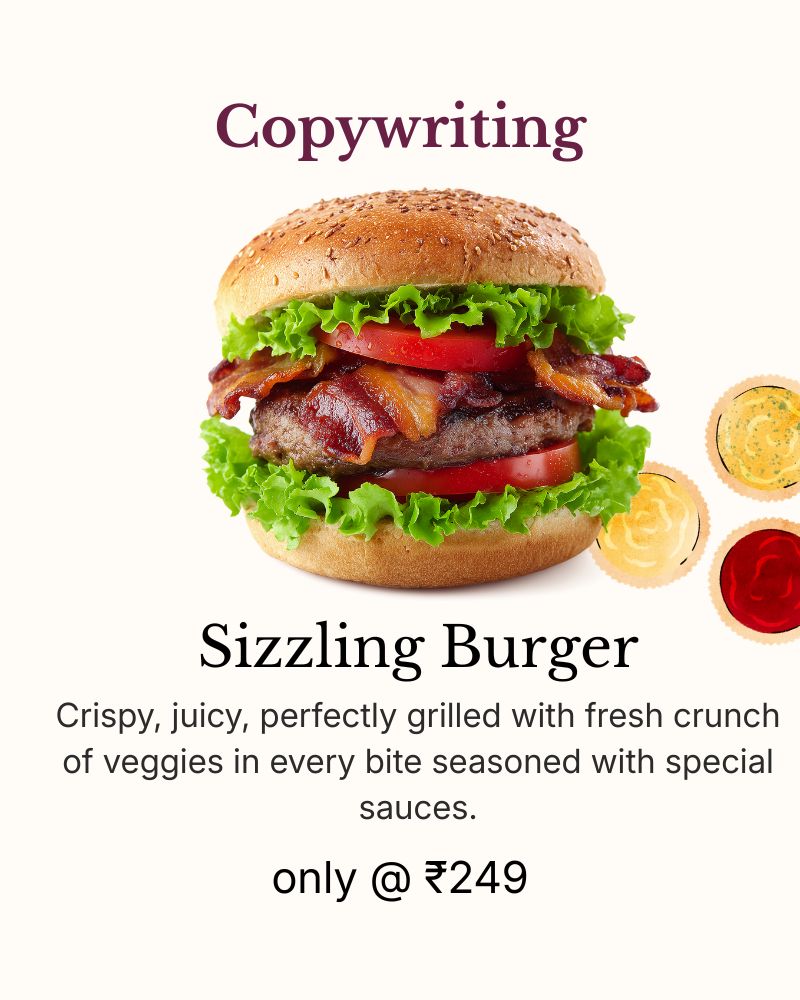
Tempting burger
Now, let’s break this down further to understand the difference between content writing and copywriting across some key principles:
| Aspect | Content Writing | Copywriting |
| Goal | Educate, inform, and build trust | Persuade and drive action |
| Format | Long-form | Short-form |
| Approach | Informational and value-driven | Persuasive and emotion-driven |
| Timeline | Long-term impact | Immediate results |
| Focus | Providing knowledge and clarity | Creating desire and urgency |
| Tone | Detailed and explanatory | Crisp, catchy, and impactful |
| Outcome | Builds authority and audience trust | Drives clicks, leads, or sales |
| Examples | Blogs, SEO articles, eBooks, guides | Ads, landing pages, email campaigns |
Now that the fundamental differences and basics are clear, let’s see how they work together in the real world, where they often go hand in hand.
Real World Applications of Content Writing and Copywriting
By now, we understand what content writing and copywriting are.
But in the real world, brands rarely use them separately. Instead, they work together more often than you think and work together as part of a complete content marketing and copywriting strategy.
Let’s understand this with a simple example.
Imagine you came across a skincare brand online.
You read a detailed blog that explains how to build a perfect skincare routine and educates you about your skin type.
This is content writing. It educates, builds trust, and helps you understand the product.
Now, on the same website, you see a line like:
“Get clear skin in just 7 days – try it now.”
This is copywriting. It is short and persuasive, designed to make you take action.
This is how most brands use both together in digital marketing.
Content to build trust, while copy converts that trust into action.
Once you start noticing this, you will see it everywhere, from websites to ads to social media and emails.
Why Content Writing and Copywriting Are Often Confused?
One of the main reasons people confuse content writing and copywriting is simple — both involve writing. In digital marketing, the same person handles both roles, and similar strategies, like SEO, are used across both.
However, there are a few core reasons behind this confusion:
- Many job roles today expect one person to handle both content writing and copywriting tasks.
- Both are used to help businesses grow through engaging and trustworthy communication.
- In digital marketing, there is a significant overlap between content and copy as they often appear together.
- With increasing demand for holistic professionals, the true distinction between them often gets blurred.
This is exactly why these two roles are often used interchangeably and widely misunderstood, even though their core purposes are different.
Essential Skills to Become a Successful Content Writer and Copywriter
Even though content writing and copywriting both rely on writing, their intent is different because their goals are different. To grow as a writer in today’s digital world, you need a mix of creative, strategic, and technical skills.
Let’s take a quick look at what it takes to become an efficient and industry-ready writer.
A. Core Writing & Thinking Skills
- Clarity of thoughts
When your ideas are structured, your content becomes easy to follow because clear thinking is reflected in your writing. - Purpose-driven writing
Whatever kind of content you are writing, be it for informing, engaging or conversion, every piece of it should have a goal. - Creative Storytelling
In the competitive field, the way you present your ideas through stories makes your content engaging, memorable and unique. - Hook and curiosity building
As attention spans are decreasing, it is essential to have a strong opening that grabs attention and encourages the reader to continue.
B. Research & Understanding Skills
- Research skills
To write accurate, credible and valuable content, strong research is needed. Or else with surface-level information, your work would feel shallow and incomplete. - Understanding audience
When you understand your target audience, you will be able to write in a way that naturally connects with their needs, problems, and expectations. - Knowing Your Topic Inside-Out
You will only be able to write with confidence and full authority when you understand your topic completely.
C. Persuasion & Communication Skills
- Basic Psychology & Persuasion Understanding
Understanding what influences people helps you write in a more impactful way. - Language & Tone Control
Adjusting your tone based on your audience and platform will always make your writing more effective.
D. Technical & Growth Skills
- SEO understanding
Along with proper writing, an understanding of at least basic SEO is a must. It will help your content reach the right audience through search engines. - Editing & Refinement
Never depend on your first drafts because they are rarely perfect. Editing helps improve clarity, flow, and overall quality. - Adaptability
To thrive as a writer, you need to be able to adapt to write in different styles and formats as and when needed.
E. Professional Mindset
- Consistency & Discipline
Regular practice is what actually improves your writing over time. Make a habit of daily writing something meaningful. - Quality over quantity
Writing more without focus feels like noise. So, always prefer to write impactful copy even if the quantity is less. - Ownership & Reliability
If you are dependable and responsible with your work, it will help you grow professionally and establish trust.
Now that you know what it takes to become a professional writer, the next question becomes more personal — which path aligns better with your goals?
Which Career Path Should You Choose?
One of the most common questions among beginners is what to choose between content writing and copywriting as a career. But the right way is to decide what aligns better with how you think, how you want to grow, and how you prefer to write.
When I first came across both, I thought they were the same until I realised that both demand different ways of thinking.
So, initially, you don’t really have to make a strict choice. Start with what fits naturally with your strengths, personality, and curiosity.
Choose Content Writing if you:
- Enjoy explaining ideas in depth
- Like researching and learning continuously
- Prefer long-form writing like blogs, guides, articles
- Comfortable with slow and steady results
- Want to build authority and personal brand over time.
Content writing is for those who truly enjoy writing in depth and believe in building trust before asking for action.
Choose Copywriting if you:
- Enjoy influencing decisions
- Interested in understanding human psychology
- Prefer short, impactful writing like ad copies, emails, and landing pages
- Want to see faster and measurable results
- Are comfortable with experimentation and working under pressure
You can be an excellent copywriter if you can drive action with your words, and not just aim for attention.
But in the real world, making a choice isn’t always this clear. Many roles today expect you to do both – write content that educates and copy that persuades.
Therefore, the smartest approach is to start with one that feels natural to you and gradually explore both and build skills, instead of choosing one and limiting yourself.
AI vs Writers:
What’s Really Changing in Content Writing and Copywriting?
As AI tools become more common, many people wonder whether content writing and copywriting are still reliable career choices. There is growing speculation that AI will replace writers. This has created uncertainty in the market, especially among beginners.
AI is indeed changing how writing is done. But the demand for good writers is still there. Here’s the truth: AI can generate good content within seconds, but it cannot think strategically, understand the purpose deeply, or truly connect with the audience.
In reality, AI is just a tool and not a replacement.
Like any other tool, it does have some flaws, and its effectiveness depends on how it’s being used. You will thrive when you learn to leverage AI rather than seeing it as your competitor.
Here’s the take for every aspiring writer:
If your only focus is on writing, you will struggle. But if you learn to think, understand, and communicate with purpose, you will be valuable.
Common Writing Mistakes Beginners Should Avoid
There comes a phase when most writers feel stuck, struggle, or start doubting their progress. But that doesn’t mean they lack skills; it happens because they keep on repeating the same small mistakes without realising it.
If we list all such mistakes, then it will be endless. But here are some of the most common writing mistakes that are often ignored or underestimated:
- Writing without a clear goal
It’s more like shooting in the dark. You directly start to write without knowing the purpose. The result? It won’t connect or land with your audience. - Less thinking, more writing
If you write without planning or structuring your ideas, it will often lead to messy and directionless content. - Ignoring audience
The biggest mistake is to write what you want and ignore what your audience needs. - Lack of clarity
Writing overcomplicated content using many fancy words or jargon doesn’t make you a better writer. Remember, clarity always wins. - Poor or no hook
In the digital age, with a shrinking attention span, if you fail to attract readers in the first few seconds, you will lose them. - Not editing
Some people avoid editing their content and consider the first draft to be final. It’s more like leaving your work half-baked - Inconsistency
Many writers in the initial stages write only when they feel like writing. This will slow down your growth and momentum. Consistency builds real progress.
Most of these mistakes have less to do with writing itself and more with how you think before writing. Fixing them seems easy, but believe me, it will make a huge difference in how your content performs.
Try it yourself — and see the difference.
FAQs
Conclusion
I used to think content writing and copywriting were different names for the same thing. It took me a while to realise they require different ways of thinking.
Content writing taught me to slow down, explain better with clarity, and focus on building trust through research. Copywriting challenged me to be precise with words, think sharply, and write in a way that drives action.
Today, I rarely see them as separate paths because in the real world, they naturally blend together more often than we realise.
So if you are confused or feeling stuck about where to start, then there’s no perfect answer. You only need to start from where you are and stay consistent. This is the first step. Later, your strength and interest will automatically guide you.
Because in the end, it’s not about choosing between content or copy. It’s about knowing what to write, how to write, and when to write it so that you create the right impact.
Till then, keep writing and keep learning.
Great content! Keep up the good work!